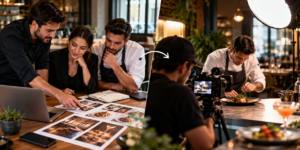
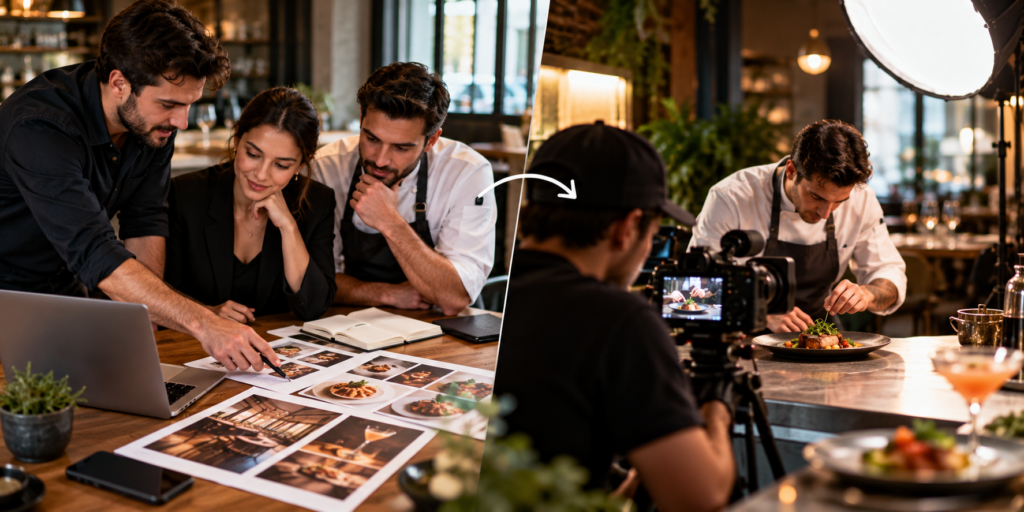

Why Content Planning Matters More Than the Shoot
You will get clean footage, perfect lighting, and well-composed photos by professionals.
None of this addresses the most crucial question:
What is this content supposed to accomplish for the business?
When it comes to hospitality businesses, the question needs to be answered prior to the arrival of the photographer, prior to the plating of the first dish on camera, and prior to anyone hitting “record.”
Having a solid content strategy ahead of time makes the photoshoot a promotional activity rather than merely a production process. In the absence of such strategy, even the best of photos and videos will be left unutilized, languishing in some common file because no one knows how and where to promote them or what message to include.
This is precisely why we have the Content Day process at Blue Moon Marketing starting with a commercial challenge, not with the camera.
The shoot is an execution.
The strategy is first.
The Most Expensive Content Is Not the Expensive Shoot
Expensive content does not mean high-cost production content.
It means content which is paid for, produced and delivered but there is no commercial reason for it to exist.
A venue could pay for professional photography and video production and even finish its production and be left with the following question:
“What are we going to post first?”
The answer to this question should come before the shooting starts.
In case of hospitality content production, a shoot will be more effective if the business already knows what it wants to achieve with the content.
The venue may need content to:
launch a new menu, fill its function room, get more bookings on weekdays, organize an event, promote a seasonal offer or a certain product which is not well-known by the customers.
They are different problems and they do not require the same content.
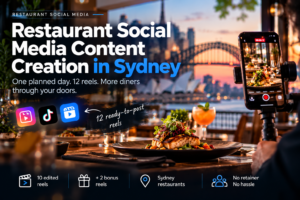
The existing Content Day service from Blue Moon Marketing works precisely on this idea. The service is aimed at venues which need something promoted, and one shoot for 10 edited reels plus 2 additional reels costs $1,750 + GST.
The number of reels is important.
However, the purpose of each reel is more important.
There is no need in ten different shots showing how great the food in a hospitality venue looks.
It needs content explaining why a client should notice, consider, trust and choose this particular venue.
And it can be done only through pre-shoot content planning.
What an Unplanned Shoot Produces: A Folder Nobody Opens
The problem is usually not that the video footage comes out looking poor.
It is rather that the footage has no function.
Consider a restaurant that hires a production company to shoot video.
The company shoots the restaurant’s exterior, a bartender preparing a drink, a few dishes, the chef in the kitchen, guests seated at a table, and slow-motion shots of drinks being poured.
All is well.
After a week passes and the files come through, someone has to ask:
- Which shot will become the reel?
- What hook should it have?
- What offer will it back up?
- When should it be published?
- Is it meant to help with dinner reservations, bookings for events or promotion of the new menu?
- Does the footage actually illustrate the business need?
- This is when the discrepancy between the video shoot and the content strategy becomes apparent.
The video shoot answered the artistic question:
- “What looks good?”
- But it did not answer the business question:
- “What does the business need to get customers to do?”
- These are different questions.
- Effective hospitality content strategy is based on knowing what matters right now.
- And a planned approach makes batch videos more realistic. It is common in content marketing literature to recommend that the assets needed for an ad campaign should be known beforehand, rather than discovered during the publishing process, as having not been produced.
- This applies to hospitality venues as well—a planned video shoot helps avoid such problems as realising that the footage lacks a walkthrough of the function room in use.
- Or that no one remembered to film the lunch offer.
- Or that there are ten great videos but none explaining why people should go to this restaurant on a Tuesday.
- Planning is the way to prevent that from happening.
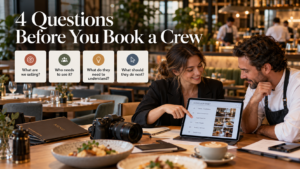
The Four Questions We Ask Before We Book a Crew
Prior to producing a hospitality content run sheet, we need to determine what the content is being asked to do.
Four questions define the production.
What are we selling?
- Not just, “What does the venue sell?”
- But,
- What specifically needs focus right now?
- It might be the new menu.
- Or the private dining room.
- Or Friday lunch.
- Or functions.
- Or cocktails.
- Or a poorly performing day of the week.
- Or a new chef, concept or venue experience.
- These questions narrow the production brief.
- If everything is important, then nothing is.
Who needs to see it?
The person booking a 40-person corporate function is not considering the same venue in the same way as the person deciding where to eat dinner tonight.
- Their questions are different.
- Their objections are different.
- The proof points they need are different.
- And that changes our approach.
- The function customer may need to see room size, table layout, the ambiance, food presentation and how it all feels with people inside.
- The dinner customer may be more influenced by food dishes, people, experiences and how it feels being there.
- Content becomes more valuable when it is targeted at a specific audience and not a vague “social media follower.”
What do we need them to understand?
- Here is where content shoot planning gets much more specific.
- Perhaps they know about the venue but don’t realise that it will take bookings for private events.
- Perhaps the menu has changed but the market still remembers its old offer.
- Perhaps the customers believe that the venue is expensive.
- Perhaps a weekday lunch offer exists but nobody knows about it.
- Perhaps there is a great function room and it doesn’t appear anywhere on the feed.
- Content must address that.
What should they do next?
- Every reel doesn’t need to include a sales pitch.
- But the campaign as a whole needs a next step.
- It might be,
- Book a table.
- Review the menu.
- Inquire about functions.
- Eat during the week.
- Order a particular dish.
- Save the venue for an occasion yet to come.
- This will determine what content we produce and how it fits into the marketing calendar.
If your venue already understands what needs to be promoted but lacks a production system to make that happen, reply “DAY” and we’ll show you what a Content Day looks like.
How Those Answers Become a Run Sheet
Once the commercial issues have been addressed, strategy can become production.
This is what the run sheet does.
An effective run sheet for content production is not just a simple schedule that lists:
10:00 – food
11:00 – bar
12:00 – staff
Instead, it must align every shooting block with a required piece of content.
In the case where the priority is new menu, specific dishes must be ready at specific times, the chef will be on duty for some shots and specific tables will have to be set up for wider venue shots.
In the case where priority is functions, then the room may have to be set up in a particular way different from trade.
In the case where priority is weekday traffic, the content needs to reflect exactly what customers will get, when they will get it and why it makes sense for them to come.
Planning is also about sequence.
Some foods will have a limited visual window.
Some areas will have to be shot before customers start to come in.
Some staff will only be available for a limited time.
Bartenders, chefs, managers and front-of-house staff will all be required for different pieces of content, but they do not necessarily have to stand around during the whole shoot.
That’s what the run sheet works out before production starts.
A run sheet can take account of:
locations, product preparation, staffing, lighting conditions, quiet times, venue set-up, props, table styling, shot order and which reel each scene will contribute to.
That is the practical distinction between “we have a shoot tomorrow” and “we have a production plan tomorrow.”
The former produces activity.
The latter produces usable content.
For a full content day output and process, see the Blue Moon Marketing Content Day proposal at /content-day and Blog 2, What a Planned Content Day Actually Produces.
Why Each of the 10 Reels Should Have a Job
- A Content Day creates 10 edited reels and 2 additional reels.
- But we do not see those 10 reels as interchangeable videos.
- We expect each video to have a place in the content calendar.
- One could give a backstory about the venue.
- Another could highlight a certain offer.
- One could concentrate on the hero dish only.
- Another one could introduce the team behind the product.
- Another one could build credibility through the service experience.
- Another one could handle the objection.
- And another one could sell the occasion rather than the product.
- This is the difference between a content library and randomly collected footage.
- And before the shooting, we need to know the content job.
- For instance:
- Cinematic venue reel may help someone to get familiar with the environment.
- Chef reel could make him familiar with the authority.
- Product detail reel could highlight the hero dish.
- Offer led reel could provide reasons for visiting during a certain trading period.
- Function space reel could help to envisage the event in the venue.
- These pieces may look very similar in their production.
- But in terms of commercial strategy, they will play different roles.
- This is also the reason why asking a videographer to “create lots of content” will not be enough.
- Quantity does not mean strategy.
- A restaurant could have hundreds of clips and yet have a problem of posting them regularly since any decision regarding publishing would need to be taken anew.
- The purpose of pre-production is to take those decisions beforehand.
- By the moment of editing, we should know the purpose of shooting the footage.
- And when the reels are finally ready, the venue would not stare at the reels not knowing what to do next.
- Blog 7, How to Use 10 Reels Over a Month, is the next step in the content strategy journey.
What We Do Differently for a New Menu, a Function Space and a Weekday Trading Problem
The first and foremost argument for having a content strategy prior to any photoshoot is that every business problem necessitates different footage.
Let us consider three examples from the hospitality industry.
Venue Launching a New Menu
- Here the commercial problem is that of raising awareness of the product.
- The shoot schedule must therefore provide enough production time for this purpose.
- It may mean focusing on hero dishes rather than trying to include everything on the new menu.
- It may mean showing preparation, plating, ingredients, interaction with the chef and the ready dish.
- It may also mean shooting wider shots, which will relate the menu to the dining experience.
- As important as what is included, is what is not included.
- In case of an outdated menu item being phased out of the menu, it would hardly make sense to take production time of the best looking item, just because it is photographically attractive.
- Production time follows the marketing objective.
Venue Selling Function Space
- While food is still important, the decision to purchase is broader.
- The person who is researching the venue must understand its function room.
- What is it like?
- What kind of event can take place there?
- What is its style?
- What is the guest experience like?
- Is the venue appropriate for a birthday party, engagement party, corporate event, celebration etc?
- In this case, spending the majority of production time on close up shots of food could mean missing some of the most critical aspects of selling the function space.
- The content strategy should allow the function room to become visible.
- This may affect the run sheet, access required as well as the preparation for the filming.
Venue Suffering From Weekday Trading
- Yet another situation.
- The venue already has great brand photography.
- This is not a problem anymore.
- The problem here is about offering consumers a reason to visit the venue at a certain time.
- In this case the content is completely different.
- The best reel to show is offer-led, occasion-led or convenience led.
- It may focus on the lunch experience, post-work visit or any other weekday occasion.
- The content should be tailored to solve the problem.
- This is why the content strategy for Blue Moon Marketing’s Content Day positioning is so effective: the strategy is best applied to venues that know their commercial needs.
- This is also why our approach to the planning of a proof-case photoshoot is what it is.
- Rather than treating “shoot everything” as the objective, we pick up the necessary footage and leave out the rest.
- Editorial case-study note: insert the specifics of the proof-case venue here – precisely what was prioritised during the planning process and couple of things that were deliberately left out of the run sheet. This information should come from the client-approved case study, not from the article.
- Just one example will make our methodology much clearer.
Content Strategy Before a Photoshoot Also Protects the Venue’s Time
Hospitality crews are not infinitely available.
- Chefs have prep.
- Managers have service.
- Bartenders have setup.
- Front-of-house teams have guests.
- An inadequately planned shoot becomes disruptive, as decisions which ought to have been taken before production begins are taken during the time the team are meant to be working.
- Which foods are we filming?
- Who will be in the shot?
- Has the function room been prepared?
- Where are we filming?
- Can we move that table?
- Do we need the chef?
- Should we film the cocktails?
- And so on.
- Each of these questions adds an additional distraction.
- A well-planned run sheet eliminates many of the decisions that must be taken on the day.
- It also assists the venue in understanding what needs to be available and when.
- For those venues who are worried about the operational side of production, How to Shoot Hospitality Content Without Disrupting Service in Blog 6 will help them out.
- The objective is not just efficiency in production.
- It is efficiency for the venue itself.
What Usage Rights Mean and Why We Hand Them Over
Content planning should also address another question, one that is sometimes forgotten:
What are you actually entitled to do with the content once it is delivered?
Not having usage rights and not having copyright or being entitled to it are two different things.
According to the Copyright Act in Australia, copyright owners have certain rights to reproduce, publish and communicate copyright material and copyright can be transferred or licensed. The Australian Government suggests obtaining permission in writing in case of use of copyright material with permission of the copyright owner.
Photography is especially important to discuss as the ownership depends on the kind of commission and terms of contract. According to the Copyright guide for Australia, apart from exceptions, creators may initially possess copyright, and contractual agreements are likely to change this.
Therefore, the business needs to be aware of the usage terms before the commercial content commission.
Can the business use the content organically?
Can the content be used in the website?
Can it be used for paid advertising?
Is it possible to repurpose the content in the future?
Can any other marketing supplier work with the files?
Can the footage be used in a marketing campaign in the future?
It is crucial for the business as the more usage possibilities the content has, the more value it will create for the organization as it can be deployed where the clients meet the brand.
For Blue Moon Marketing’s Content Day, the idea is quite simple – we give the right to use the agreed content to the venue in order to use it.
This is important not only for our planning but also for the production itself.
We produce reels not just to look great in a delivery folder.
We create marketing content to be used.
And it should be possible based on the usage rights.
As for comparison of a Content Day and creation of an internal production capability, Blog 5, Content Day vs Hiring In-House, covers the differences between the approaches.
A Better Shoot Starts Before the Camera Comes Out
If you have tried professional hospitality content before and felt disappointed, the first question should not necessarily be:
“Was the production quality good enough?”
Ask instead:
Did we know what every piece of content was supposed to achieve before the shoot happened?
A technically excellent reel cannot fix an unclear marketing objective.
A beautiful restaurant photo cannot promote an offer that was never captured.
A folder full of content cannot create a strategy that did not exist beforehand.
The planning stage determines what gets filmed, who needs to be involved, how the production day is organised, what gets left out and how the finished content can support the venue after delivery.
That is why we treat content strategy before the photoshoot as part of the production itself.
For a Content Day, the deliverable is clear: 10 edited reels plus 2 bonus reels.
But the real work begins before those reels exist.
We decide what the venue needs to sell.
We identify who needs to see it.
We determine what that audience needs to understand.
Then we build the run sheet around those answers.
The camera comes later.
If your venue knows it needs better content but does not want another shoot that produces a folder with no plan behind it, book a fit call with Blue Moon Marketing and we can work out whether a Content Day is the right production model for your venue.