Growth Marketing Agency Australia: A Complete Guide to Growing Your Business In 2027
Building up a company in Australia entails more than just driving traffic and being active on social networks. Companies have to be aware of their customers, take advantage of the right opportunities and integrate their marketing efforts with specific business objectives.
At Blue Moon Marketing, our team works on growth marketing by focusing on strategy, customer acquisition, digital performance and visibility. We believe that rather than treating SEO, PPC, social and content marketing as entirely independent processes, growth marketing involves integrating them through one shared goal of supporting companies in acquiring, converting and retaining their customers.
A growth marketing strategy can help companies working in highly competitive markets find opportunities and improve their digital performance.
But what is growth marketing, and how can a growth marketing agency in Australia help your company?
What Is Growth Marketing?
Growth marketing is an approach to marketing that uses data and considers the customer experience as a whole and not just part of it. Marketing activities may concentrate primarily on the stages of gaining awareness and acquiring new clients. Growth marketing takes it further by looking at what occurs both prior to, during, and following an interaction between the client and the company.
This can include:
- Raising brand awareness
- Gaining website visitors
- Creating qualified leads
- Optimizing conversion rate
- Customer retention
- Increasing repeat business
- Exploring marketing opportunities
- Campaigns tracking
The growth business advice provided by the Australian Government includes market research, defining measurable growth goals, reviewing marketing strategies, and creating a digital strategy. Growth marketing operates based on the same idea, which is that marketing activities need to correspond to the set goals and be evaluated through performance data.
Growth Marketing vs Traditional Marketing
Both growth marketing and traditional marketing could utilize the same platforms, although the way that these platforms are used might differ.
For instance, traditional marketing revolves around the concept of campaigns, promotions, and brand awareness. Growth marketing is all about experimenting, measuring and optimization of the customer journey.
For example, instead of simply launching a Google Ads campaign, a growth-focused approach may examine:
- Which audience the campaign reaches
- Which search terms generate enquiries
- Which landing pages convert
- Which messages generate engagement
- How much each lead costs
- Which leads become customers
- Where potential customers leave the journey
This creates a continuous feedback loop.
Launch → Measure → Analyse → Improve → Test again
That process can help businesses make marketing decisions based on evidence rather than assumptions.
Growth Marketing | Traditional Marketing |
Data-driven and focused on measurable results | Often focused on reach and brand awareness |
Continuously tests and improves campaigns | Campaigns are usually planned for a set period |
Looks at the entire customer journey | Often focuses mainly on attracting customers |
Uses SEO, PPC, social media, email and other channels together | Often relies on specific channels such as TV, print, radio or outdoor advertising |
Uses customer data to refine strategies | Audience targeting may be broader |
Frequently experiments with messaging and creative | Creative and messaging are often set before launch |
Measures conversions, leads, acquisition costs and revenue | Often measures reach, impressions and overall campaign response |
Strategies can be adjusted based on performance | Changes may happen less frequently |
Why Australian Businesses Need a Growth-Focused Marketing Strategy
The Australian business environment is very dynamic, with firms competing in a local, national, and international market. A firm that provides its services to clients in Sydney might have marketing needs different from those of an eCommerce business which operates in the entire country.
Likewise, a professional service firm might have a different acquisition plan from that of a hospitality business or health care business or a trade business.
Understanding The Australian Market–
Before choosing how to market the product or service, the business should know:
- Whom the targeted customers are
- Where they can find them
- What problems they have
- How they compare businesses
- The products offered by competing businesses
- The locations served
- What affects the purchase decision
According to the Australian Government, businesses should analyze their customers, competition, market demand and marketing channels before planning a digital strategy.

What Does a Growth Marketing Agency Do?
Growth marketing agencies help businesses design and optimize their marketing activities in different phases of the customer’s journey. While the services may differ from one agency to another, a growth marketing strategy typically includes several components.
1. Search Engine Optimisation–
SEO can help businesses attract people who are actively searching for their products or services.
A growth-focused SEO strategy can involve:
- Keyword and search intent research
- Technical SEO
- On-page optimisation
- Content strategy
- Local SEO
- Competitor research
- Internal linking
- Search performance analysis
2. Google Ads and Paid Search–
Paid advertising may assist companies in reaching out to prospective customers when they are in the search for products/services. The roles which a growth marketing agency may be able to help in include the following:
- Campaign strategy
- Keyword research
- Target audience
- Ad copywriting
- Landing page
- Conversion tracking
- Budgeting
- Campaign optimization
Growth marketing is all about constantly evaluating the performance of the campaigns and not launching them once and leaving them alone. Cost per lead, conversion rates, and revenue may assist businesses in understanding whether their campaigns are helping achieve their goals or not.
3. Meta Ads and Social Advertising–
Platforms like Facebook and Instagram may provide support for customer acquisition, awareness, and remarketing. The use of social advertising can help with the following purposes:
- Introducing products to the new audience
- Services promotion
- Retargeting website visitors
- Generating leads
- Launching products
- Awareness generation
- Repeat engagement encouragement
According to the Australian Government, social media may assist businesses in attracting customers, building relationships, promoting their products, and expanding into new markets.
The growth-based strategy allows linking social advertising to marketing goals, and not measuring its effectiveness in terms of likes and impressions.
4. Content Marketing–
Content can be beneficial in more than one stage of the buyer’s journey. A new customer who does not know about a company can become aware of it via an educational post. Another buyer might read the comparison post before inquiring.
Content that is valuable includes:
- Blog posts
- Guides
- Frequently asked questions
- Case studies
- Videos
- Social media content
- Service pages
- Industry insights
It is more important to answer customer queries and offer informative posts than just to publish any kind of content.
5. Conversion Rate Optimization–
Getting people to a website is only one part of growth.
The next question is:
What happens after they arrive?
Conversion rate optimization, or CRO, focuses on improving the percentage of visitors who complete a desired action.
This could include:
- Submitting a contact form
- Calling the business
- Booking an appointment
- Requesting a quote
- Making a purchase
- Signing up for an email list
Small improvements to page structure, messaging, forms, calls to action and user experience can influence how visitors move through a website.
6. Email Marketing and Customer Retention–
Growth does not always mean finding new customers. Existing customers can also contribute to business growth through repeat purchases, renewals, referrals and additional services.
Email marketing can help businesses:
- Keep customers informed
- Share useful content
- Promote relevant products
- Re-engage previous customers
- Support launches
- Build long-term relationships
A growth strategy should therefore consider both acquisition and retention.
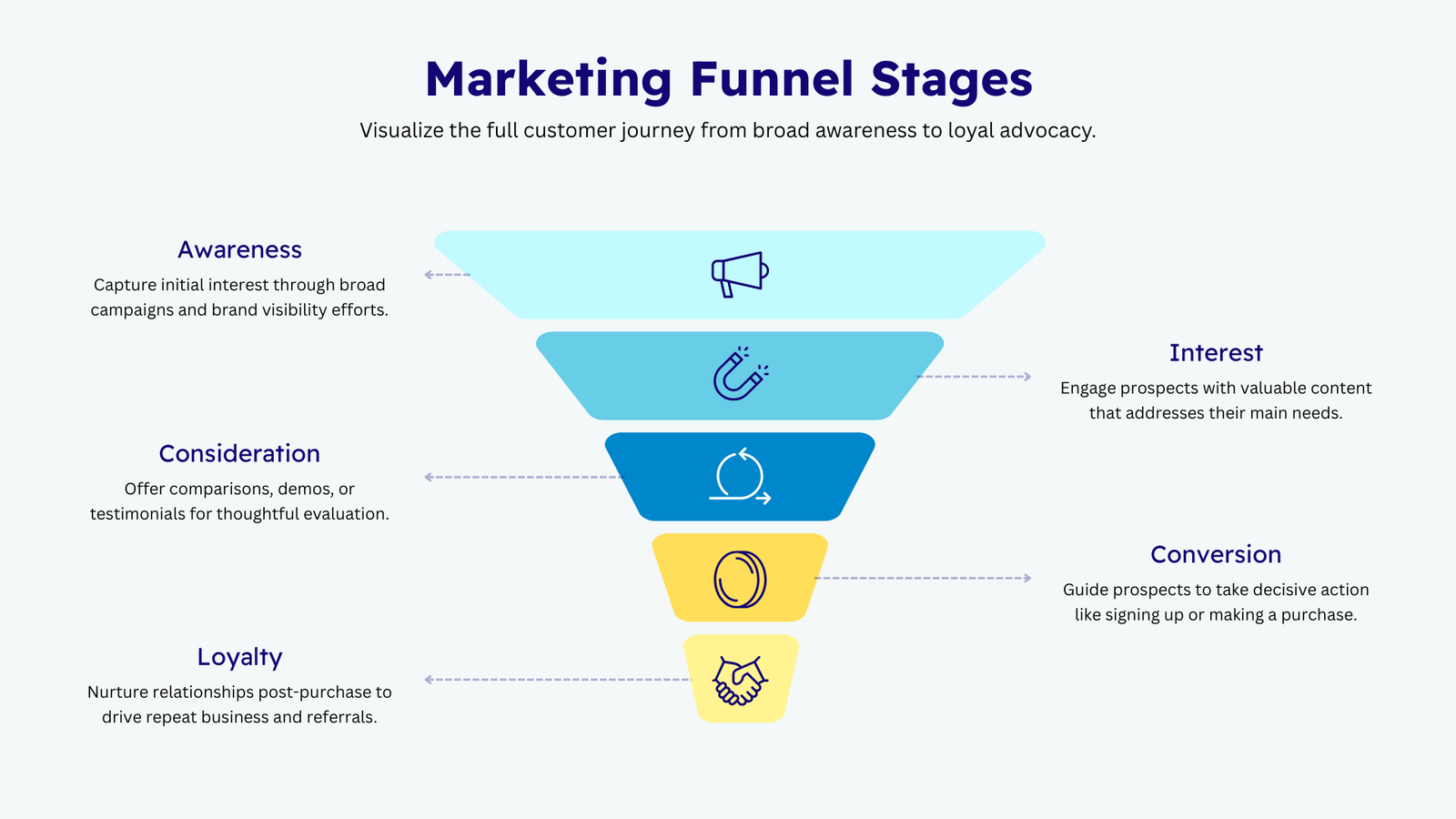
The Growth Marketing Funnel
A growth marketing strategy can be viewed through different stages of the customer journey.
Awareness
At this stage, potential customers may not know about the business.
Marketing activities can include:
- SEO
- Social media
- Video
- Display advertising
- Content marketing
- Brand campaigns
The goal is to introduce the business to relevant audiences.
Consideration
The customer knows they have a need and is researching potential solutions.
Useful marketing assets can include:
- Service pages
- Comparison content
- Guides
- Reviews
- Case studies
- FAQs
- Educational videos
At this stage, credibility and useful information can help customers evaluate their options.
Conversion
The customer is ready to take action.
This is where businesses should make it easy to:
- Contact the business
- Request a quote
- Book a consultation
- Purchase a product
- Submit an enquiry
Clear messaging and simple calls to action can reduce unnecessary friction.
Retention
After conversion, businesses can continue communicating with customers through:
- Email marketing
- Loyalty campaigns
- Remarketing
- Customer support
- Personalized offers
- Educational content
Retention is an important part of sustainable growth because the relationship does not necessarily end after the first transaction.
Data and Analytics in Growth Marketing
Continuous measurement is one of the most notable aspects of growth marketing. It allows companies to see what activities bring them success and where they should make changes.
Some useful KPIs are:
- Website visits
- Leads
- Conversion rate
- Cost per lead
- Customer acquisition cost
- ROI of advertising efforts
- Revenue
- Retention rate
- Email marketing engagement rate
- Organic search performance
According to the Australian Government’s advice, the best KPIs are those associated with the objectives set for digital marketing.
Why Data Matters?
Imagine a business receives 10,000 website visitors but only generates 20 enquiries. Increasing traffic further may not solve the main issue.
The business could instead investigate:
- Which pages receive the most traffic
- Which pages generate enquiries
- Whether calls to action are clear
- Whether visitors are finding relevant information
- Whether the website works well on mobile
- Whether the traffic is coming from the right audience
This is where growth marketing becomes an ongoing optimisation process.
Experimentation and Testing
Growth marketing often involves testing different approaches rather than assuming that one strategy will work permanently.
Businesses can test elements such as:
Website Headlines- Compare different messages to understand which communicates the value proposition more effectively.
Calls to Action- Test different CTA wording, placement and page structures.
Advertising Creative- Compare different images, videos, headlines and messages.
Landing Pages- Test different layouts, forms and content structures.
Email Campaigns- Test subject lines, messaging and calls to action.
The purpose of testing is not to change things randomly. Each test should have a clear objective and measurable outcome.
How a Growth Marketing Agency Can Support Different Australian Businesses
It is possible to adapt growth marketing strategies for different types of business sectors.
Professional Services- Law firms, accountants, consultants, and agencies can concentrate their marketing efforts around lead generation, SEO, authoritative content and conversion optimisation.
Ecommerce- Ecommerce companies could consider paid advertising, SEO, product page optimisation, remarketing, email marketing and customer retention marketing.
Trades- Businesses such as plumbers, electricians and builders could consider local SEO, Google My Business Optimisation and paid search.
Healthcare- Healthcare businesses can focus on local visibility, informative content, search optimisation, reputation and clear customer journeys.
Hospitality- Restaurants, hotels and hospitality businesses can use local search, social media, paid advertising, content and customer reviews to attract and retain customers.
The right combination depends on the business, audience, market and growth objectives.
Why Choose Blue Moon Marketing as Your Growth Marketing Agency in Australia?
Our philosophy at Blue Moon Marketing when it comes to growth marketing consists of uniting various digital channels under the umbrella of an individual business’ needs.
By employing more than one marketing strategy, we can provide a variety of options such as:
- SEO
- Local SEO
- Google Ads
- Meta Ads
- Social media marketing
- Content marketing
- AI search marketing
- Conversion-based website strategy
- Performance marketing
Furthermore, the Australian Government recommends choosing channels depending on the target audience, goals of a business and its resources instead of using all possible digital channels automatically.
This aspect is vital for growth marketing because a business is not required to operate everywhere. What is crucial is knowing where its customers are and what actions align with its objectives.
The Future of Growth Marketing in Australia
Growth marketing will keep evolving with developments in technology and changes in consumer behavior.
With artificial intelligence technologies, shifts in the search experience, automation, personalization and advancements in advertising, there are further opportunities for businesses to interact with their consumers.
However, certain basic principles should not be overlooked:
- Know your audience
- Know your market
- Define your goals
- Select the right channels
- Create valuable content
- Make it easy to convert
- Track performance
- Continually improve
By combining these basic principles with new digital marketing opportunities, companies can develop a flexible approach to marketing.
Frequently Asked Questions (FAQs)
What is a growth marketing agency?
A growth marketing agency helps businesses attract, convert and retain customers using a combination of digital marketing strategies. This can include SEO, Google Ads, Meta Ads, content marketing, conversion optimisation and data analysis.
How is growth marketing different from traditional marketing?
Growth marketing focuses on continuous testing, measurement and optimisation across the customer journey. Traditional marketing often focuses more on planned campaigns, brand awareness and broad audience reach.
What services does a growth marketing agency provide?
Services can vary, but a growth marketing agency may provide SEO, local SEO, Google Ads, Meta Ads, social media marketing, content marketing, conversion rate optimisation, email marketing and performance marketing.
Can a growth marketing agency help small businesses in Australia?
Yes. Growth marketing strategies can be adapted to businesses of different sizes. A small business can focus on specific audiences, locations and channels rather than trying to use every available marketing platform.
How long does growth marketing take to show results?
The timeframe depends on factors such as the industry, competition, marketing channels, budget and starting point. Paid advertising can generate data relatively quickly, while SEO and content strategies generally require more time to build visibility and authority.
Why should I choose Blue Moon Marketing for growth marketing?
Blue Moon Marketing takes a multi-channel approach that can combine SEO, Google Ads, Meta Ads, local SEO, content marketing, AI-powered search strategies and performance marketing based on a business’s goals and target audience.
How does Blue Moon Marketing measure growth marketing performance?
Blue Moon Marketing can use metrics such as website traffic, leads, conversion rates, cost per lead, advertising performance and other relevant business metrics to evaluate marketing activity and identify areas for optimisation.
Is growth marketing suitable for eCommerce businesses?
Yes. eCommerce businesses can use growth marketing across SEO, paid advertising, product page optimisation, social media, remarketing and email marketing. These channels can work together to attract new customers and encourage repeat purchases.
Can growth marketing help with local businesses?
Yes. Local businesses can use growth marketing strategies such as local SEO, Google Business Profile optimisation, location-focused content, paid search and social advertising to reach customers in relevant service areas.
How can I start a growth marketing strategy in Australia?
Start by identifying your business goals, target audience, competitors and current marketing performance. From there, select the channels that align with your objectives and establish measurable KPIs. Blue Moon Marketing can help businesses develop a growth-focused digital strategy based on their specific needs.
Final Thoughts
An Australian growth marketing agency could be used to enable businesses to take a look at marketing as a process and not as a set of disconnected campaigns.
There are many different types of channels available from SEO and Google Ads to Meta advertising, content, local search and conversion optimization that can be used in a coordinated fashion to support the customer journey. The first thing that needs to be done is to figure out what the business wants to do and build a marketing strategy based on these aims.
Blue Moon Marketing can assist Australian companies to build digital marketing strategies that link visibility, customer acquisition and performance metrics together. Regardless whether the goal is lead generation, increased online sales or market expansion, the growth marketing approach enables you to measure and test your marketing efforts and to continuously optimize your strategy.
Regardless of the developments in the digital world, growth marketing allows companies to focus on the right things: Understanding the customer and measuring performance.