
Restaurant Photoshoot Planning: How to Shoot Venue Content Without Disrupting Service
It’s obvious if you own a restaurant, bar or cafe because you can imagine right away what a photoshoot looks like: tripods blocking the way; a light stand in the place where the pass is; somebody asking a chef to wait with a plate of food while tickets are piling up.
This is the image people see in their minds when they say that “we don’t have the time to do this now.” The claim is justified, but it is largely due to poor planning and not a camera.
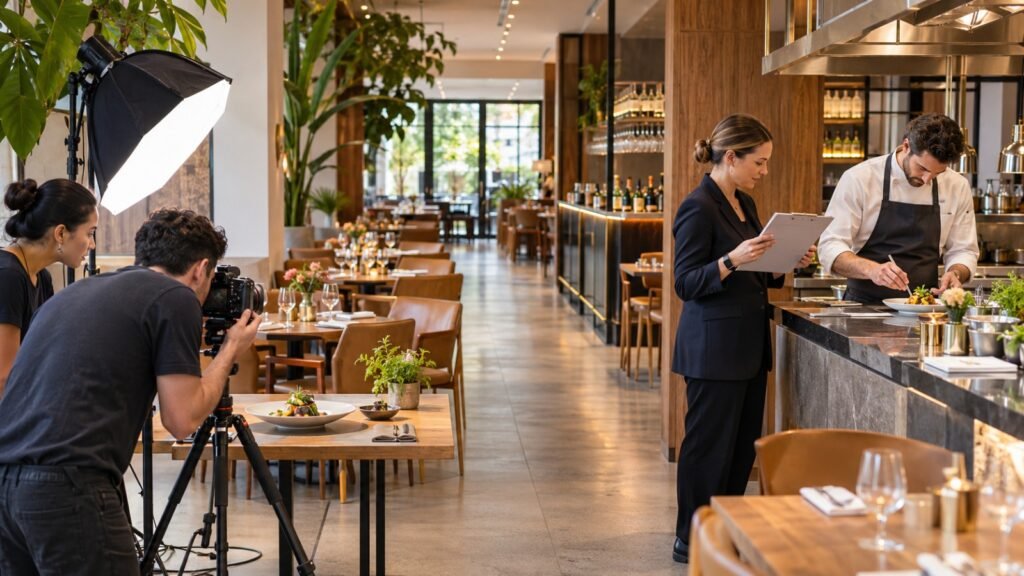
Photoshoot planning for a restaurant is the planning done prior to shooting: selecting the window, deciding where the crew will work, which plates will be photographed and in what order. Properly done it ensures that the shooting does not interfere with your operations but happens according to your schedule. Here I will discuss the process and provide you with an example of a shoot schedule at the end of the post.
TLDR: the photoshoot of your venue does not have to interfere with service. Plan the shooting on your quiet window, give the crew certain spots and make sure their participation is limited to several quick tasks.
The real fear: a camera crew in the way during service
The fear, in essence, revolves around three scenarios. The equipment placed in the walkways. Your staff being taken away from the floor to hold plates, move tables, or answer the crew’s questions. A kitchen that gets slower because of someone who wants another take of the pasta.
These scenarios are likely on a poorly organized shoot. None of them is inherent in the shoot process. They appear when the crew comes without any plan in place and during a peak time in the establishment with no venue mapping or order of operations and works its way around your guests.
A well thought-out plan prevents any improvisation. All of the details concerning the location of the crew throughout the process, off-limits areas and times, as well as required members of your team and their time spent there, are agreed upon in advance. At Blue Moon, the run sheet includes all the details concerning locations, staffing, lighting, quiet times, props, and shooting order, as well as shooting blocks associated with a particular reel. The logic behind that lies in the importance of content planning over shooting.
Here is the reframing that is required. The service doesn’t have to be filmed in order to produce great content about it. The food, space, and people need to be caught on camera in the right light, so that it looked as good as your Friday nights.
How we schedule around your trading pattern
We start with one question: when is the venue quietest? Your booking system, your rosters and your own gut will usually agree. Then the day gets built around that window, not the other way round.
Trading pattern | Best shooting window | Typical venues |
|---|---|---|
Lunch and dinner, with a gap between | Afternoon gap for kitchen and hero dishes; the morning before opening for the empty room | Restaurants, bistros |
Dinner only | Late morning to mid-afternoon, around your prep | Wine bars, bistros, fine dining |
Breakfast and lunch | After the lunch rush, through the afternoon | Cafés, bakeries |
One closed day a week | The whole closed day, as one continuous run | Pubs, function venues, anywhere with a dark day |
A rough guide only. We adjust it after a walkthrough of your venue.
There are a few basic principles underlying all of this. Items requiring kitchen staff are done during the graveyard shift between services. Anything requiring the dining room to be pristine is done either prior to opening or during the late afternoon cleaning period. Anything requiring actual customers is confined to an efficient, brief window, if at all desired.
A closed day is the easiest solution by far. Everything becomes much simpler as the room must simply be prepared once during the day. Not having a closed day? A quiet time slot will do just fine.
Lighting is another factor we consider during the walkthrough. A room can change significantly from 10am to 4pm, and the hour that is the quietest for your business is not always the room’s peak time for lighting.
What we need access to, and for how long
Access is the scary part, so we write it down prior to the day. In layman’s terms, we require:
- An empty dining room for a block prior to opening or in the middle of the afternoon break
- The bar for drinks and glasses
- A clean bench or space on the pass for plating single portions of hero dishes
- Kitchen, outside of service, for chef and prep footage
- Bags and case space which is not a walkway
The other key component is the time. This is especially true of the kitchen which gets the tightest and shortest block in written agreement and it’s slotted into the downtime after lunch service is cleaned down. The dining room and bar blocks are longer but they fall into the time when no one requires the use of those rooms. As you can see from the sample run sheet below, the head chef requires around an hour and a quarter in total time and not once does this overlap with service.
Prior to the shoot day, we conduct a brief walkthrough or phone call. We ensure we’ve locked in the quiet window, the set-up location, the off-limit areas and the person to contact in case anything changes. This one call stops 95% of the nightmares.
What your team actually has to do (very little)
Much less than you think, and much of it is what you would have done before offering service anyway. The venue check list is very short indeed:
- Identify the star products and cocktails, and all other products that distinguish you
- Identify your quiet times, or offer us a closed day
- Clean the venue, the glasses and the countertops, just like you would prior to opening
- Identify staff members who are being filmed, and tell them
- Confirm that the music played during filming is properly licensed, and that the people filmed approve of it
- Appoint a single person for the day with the authority to say no-go at any point
That final point is not included on most lists, but is probably the most valuable piece of advice we can give. Single person on-site with the power to say no-go for two minutes is what keeps the set calm.
Your staff don’t direct and they don’t perform. If someone’s in frame, they’re doing their normal job. The crew handles setup, lighting, the shot list and packing out. If you’re wondering what all of that adds up to afterwards, here’s what a planned Content Day produces.
Capturing food without the kitchen losing a pass
Hero dishes do not mean live tickets. It is the core of the whole concept. We do not film food while it is being served. We film it at night in individual portions, either on a bench or in the restaurant’s dining area, following a carefully selected list.
The way it works is this:
Set the cap. A reel of hero dishes requires several dishes, not the entire menu. Set the number in advance for your kitchen to know precisely what needs to be cooked.
Plate one at a time. The dish is plated by a chef, filmed, then taken away. There will be no row of plated dishes cooling off under the lights.
Arrange according to spoilability. First go the cold dishes and desserts. Everything that steams, sauce, or has a crispy texture will go last, timed just to the moment when we start filming.
Do not use lights on the pass. All our stands and reflectors will stand on a bench or at a table, but not in the small area where your chefs cook.
Film cooking during prep, not rush. Filming knife skills, cooking in a pan or plating may all be filmed handheld in the afternoon, with minimum footprint, and a cook who is aware of it.
In case you wish to get some live kitchen activity on your final reels, we would prefer to borrow it from prep and plating, rather than your rush. The prep session on screen appears quite busy anyway and does not affect anybody’s ticket times.
Capturing atmosphere without staging the room badly
Atmosphere is the harder one, because it’s what a camera flattens first. An empty room in flat light looks empty. A room that’s been staged too hard looks like a stock photo.
The aim is to show the room the way it looks on a good night, not a better room than yours. That means:
Set the room just as you would for dinner service. Set tables, glasses out, lights, music at whatever level you normally have it.
Use your own lights. We don’t use much additional lighting. It changes how the room looks, and the guests will know the difference when they enter.
Populate the room, with care. The best case scenario is having some employees or familiar faces sitting comfortably for about 20 minutes, versus an empty room. Anyone in frame will be told.
Get some action shots of the bar. Pouring drinks, garnishing drinks, putting ice in, setting a drink down. Small, specific actions carry more weight than showing off all the bottles.
Photograph the space as a potential customer would see it. What is the capacity of the room? How does it lay out? What is the entrance like? How does it look from the head table?
One small habit saves a lot of grief. We photograph the room’s layout before anything moves, and we put it back from that photo. Furniture returns to where it lives, and the duty manager signs off before we leave. Nobody wants to find a shifted table when doors open.
If the founder does appear: how we keep it to ten minutes
There’s no shortage of owners and head chefs who’ll come on camera but will hate hanging around while a crew sets up. It takes ten minutes to get what you need, so long as those ten minutes have been planned.
It looks like this:
Two minutes getting ready. Mic on, position set, no expectation to perform.
Five or six minutes of talking. Two or three talking points sorted out the day before, said in their own words, at a place they control. No script.
Two minutes of action. Pouring, plating, speaking to a team member. This is the footage that gets used.
Two things make it happen. The talking points are sorted through the day before, so there is no blank page. Also, the time is set when it is least busy of their day, not wedged in between deliveries and suppliers calls.
If there are people who really don’t want to be on camera, there is an alternative way to do it – hands, voiceover, the back of the chef’s whites in the pass. There’s a person in it anyway.
The run sheet: a worked example
This is an example; it is not a run sheet of any previous client photo shoot. This has been made for a restaurant which serves its customers lunch between 12 and 2.30pm, takes a break after serving lunch and reopens to serve its customers dinner from 5.30pm onwards.
Time | Block | Where | Your team | Reel it feeds |
|---|---|---|---|---|
8:30 | Arrive, walkthrough, light check | Whole venue | Duty manager, 10 min | All reels |
9:00 | Empty room: layout, tables, window light | Dining room | Nobody. Room set as for dinner | Venue reel, function space reel |
10:15 | Bar and drinks: pours, garnish, glassware | Bar | Bartender, 30 min | Venue reel, offer reel |
11:00 | Reset room for lunch. Crew off the floor | Dining room | Floor team resets as normal | None |
12:15 | Live lunch atmosphere: wide shots from one agreed corner, no lights | Dining room | Nobody. Guests carry on | Venue reel |
12:45 | Crew break, back up cards, review footage | Off the floor | Nobody | None |
2:45 | Kitchen block: prep and chef at work | Kitchen, after lunch clean-down | Head chef, 30 min | Chef reel |
3:15 | Hero dishes: five plates, one at a time | Bench by the pass | Head chef or cook plating, 45 min | Hero dish reels |
4:15 | Owner or chef to camera, ten minutes | Dining room | Owner or chef, 10 min | Venue reel, offer reel |
4:30 | Dinner set: lamps on, glassware out, a few staff in frame | Dining room | Two or three staff, 20 min | Venue reel, offer reel |
5:00 | Pack out. Room back to the layout photo | Whole venue | Duty manager sign-off, 5 min | None |
5:15 | Crew gone, 15 minutes before doors |
There are three things that one should pay attention to. Firstly, the crew is not on the floor during lunch time, except for one small wide window without any lighting filmed from one agreed-upon corner. Secondly, all kitchen blocks are done after lunch clean-downs and long before dinner time. Thirdly, nobody is double-tied in a manner that does not match with the service schedule; there are two blocks for the head chef, two short blocks for the duty manager and two short blocks for the bartender.
Summarizing everything said above, the total amount of team time is quite small. It takes about one hour and fifteen minutes of the head chef’s time, thirty minutes of the bartender’s time, ten minutes of the owner’s time, fifteen minutes of the duty manager’s time and twenty minutes of time from two or three members of the crew.
See how the day is built
If what’s been holding you back is “we can’t afford the disruption”, the answer is a run sheet, not a pep talk. View the process to see how a Content Day is planned, shot and delivered.
Want to see what yours might look like? Reply “DAY” and we can explain what the Content Day process looks like. When you’re ready to talk dates, book a fit call. One Content Day is $1,750 + GST and includes 10 edited reels plus 2 bonus reels.
Still weighing it against a hire? This comparison of a Content Day and hiring in-house lays out both sides.